25/06/2026 – IVGT — auf Deutsch lesen
Erasmus+ Projekt Skills4Circularity
Recycling, traceability, eco-design and digitalisation are among the key future challenges facing the European textile industry. The Erasmus+ project Skills4Circularity focuses on the capabilities companies need to address these challenges, with the aim of identifying skills gaps and developing training programmes for a circular textile economy.
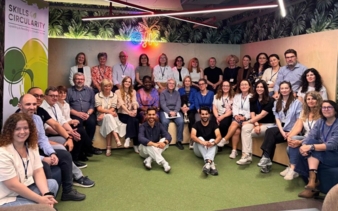
Recycling, traceability, eco-design and digitalisation are among the key future topics for the European textile industry. The Erasmus+ project Skills4Circularity, involving 21 partners from twelve countries, investigates which skills are needed, with IVGT contributing the industry perspective as the German partner. © IVGT
The project brings together 21 partners from twelve countries. The Industry Association for Finishing - Yarns - Fabrics - Technical Textiles (IVGT) participates as the German industry partner, contributing the industry perspective to the work. The analytical basis includes a Europe-wide company survey with 183 participants from twelve countries, 22 expert interviews, and an AI-supported analysis of 313 job advertisements across eleven countries.
The results point to a clear emphasis: the sector’s greatest challenges are described as lying less in a lack of technology and more in a lack of skills. Knowledge of regulatory requirements, the circular economy, life cycle assessments (LCA), data management and process integration is particularly in demand. Traceability, material sorting and sustainable production processes are also highlighted as important areas of expertise.
The project also finds that while sustainability, the circular economy and technological innovation are recognised as strategic goals across company sizes, implementation often happens incrementally and in isolation rather than as part of a holistic transformation strategy. Differences by size are noted: large companies tend to have extensive technological and organisational resources but face significant regulatory and transformation pressure. Medium-sized companies often drive functional and sustainable textile development, yet are constrained by economic conditions and customer requirements. Small enterprises are described as flexible but limited in technological capacity, while micro-enterprises are portrayed as innovative niche providers that depend strongly on partnerships and stable market conditions. Key obstacles include skills gaps, insufficient integration of processes across the product life cycle, a lack of data standards and inadequate coordination along the value chain. The analysis also notes that recycling processes are often outsourced and considered late in the product life cycle, and that eco-design is increasingly taken up in development but rarely embedded in standardised processes.
Based on these findings, Skills4Circularity is developing three practice-oriented training modules: recycling technologies, eco-design for the circular economy and sustainable production. The project runs from November 2025 to October 2029 and is also developing formats such as MOOCs, masterclasses and a European Textile Skills Observatory.