15/07/2026 – Gunold — auf Deutsch lesen
Invisible thread for discreet seams and embroidery effects
The polyester monofilament Invisible from Gunold is designed for applications where seams and attachments should recede into the background.
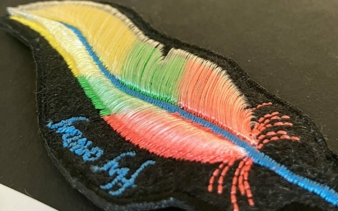
Feather design, first embroidered with standard 40 thread, then over-embroidered with Invisible. Design by Seab Italy. © Reiner Knochel, Textile Experience, für Gunold
The transparent special thread is made from 100% polyester and is used both for sewing and embroidery when the thread is meant to remain visually unobtrusive. It is also suitable for attaching sequins, beads, cords and ribbons, enabling fixations that are barely visible on the finished product.
Transparency as a design tool
With its monofilament construction, Invisible combines a sheer appearance with functional performance. In fashion applications, the transparency of the thread supports subtle looks and fine design accents, giving embroidery a delicate, distinctive character. Because the thread adopts the hue of the base fabric, it can blend into light textiles in the Clear version or create pronounced tonal effects on dark grounds in the Smoke colour. On black fabrics in particular, the result is described as a mysterious, almost mystical look.
Technical data and processing characteristics
Invisible is available in ticket number 40 with a yarn count of Nm 92. The polyester monofilament offers high tensile strength while remaining soft and dimensionally stable. This combination is intended to support reliable processing on both embroidery and sewing machines. According to Gunold's experience, users particularly appreciate the soft handle compared with conventional transparent nylon monofilaments. The thread is certified according to Oeko-tex standard 100 and offered in the colours Clear (transparent) and Smoke for dark fabrics. It is supplied on cones with a running length of 21,100 metres, with a minimum order quantity of one cone.
From invisible fastening to visible structure
Although Invisible is primarily used for the nearly invisible attachment of cords, sequins and other appliqués, it can also be processed like a standard embroidery thread. Embroidery files that have been digitised for 40-count thread can be stitched with Invisible without adjustment. This makes it possible to switch between conventional embroidery yarns and the transparent monofilament within the same design.
One option highlighted in practice is to first embroider a motif in satin stitch using a coloured No. 40 embroidery thread, then slightly enlarge the design and over-embroider it with Invisible. The second stitching pass creates a transparency effect that adds depth and fine surface structure. In this way, the monofilament allows for delicate visual accents and layered effects that are difficult to achieve with opaque embroidery threads alone. Design examples from the fashion school in Sigmaringen and motif specialists such as Seab Italy demonstrate how transparent and Smoke-coloured variants can be combined to emphasise contours or to place very subtle feather-like structures on the fabric surface.