29/09/2026 – STFI — auf Deutsch lesen
An eco-friendly alternative to fluorocarbon finishing
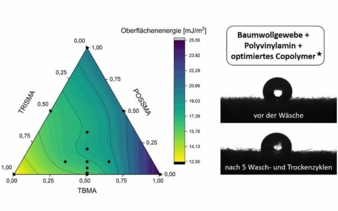
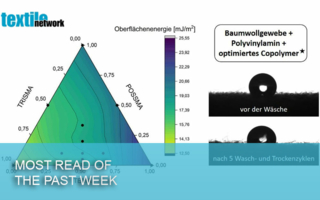
Copolymer composition and photos of the finished textile with an ethylene glycol droplet. © STFI
The work addresses environmental and human health risks associated with per- and polyfluoroalkyl substances (PFAS). These ‘forever chemicals’ are virtually non-biodegradable and are increasingly accumulating in the environment. Their use is regulated by the European REACH Regulation, and severe restrictions on their use are being sought.
In the IGF project ‘C6C8 turn green’, textile researchers from STFI in Chemnitz and chemists at the Leibniz Institute for Polymer Research developed an environmentally friendly alternative to fluorocarbon finishing. The project focused on the use of POSS (polyhedral oligomeric silsesquioxanes) and TRIS compounds ([Tris(trimethylsiloxy)silyl]) to achieve a water- and oil-repellent effect.
Two-step application
Copolymer systems consisting of tert-butyl methacrylate (TBMA) and methacrylate-functionalised POSS (POS-SMA) and TRIS (TRISMA) were specifically synthesised. For the textile finishing, aqueous dispersions of the copolymer systems were produced using mini-emulsion polymerisation. Functionalisation of the textiles began with the application of an adhesion-promoting polyamine finish comprising cross-linking agent-containing aqueous polyvinylamine or chitosan formulations. In a second process step, the textiles were functionalised with the copolymer dispersion. Application was carried out in each case using foulards, followed by thermal drying and cross-linking.
Results after washing cycles
To assess the effectiveness, functionalised cotton fabrics were examined before and after defined washing cycles at a washing temperature of 60 °C, followed by tumble drying at 70 °C. The samples achieved a contact angle against water of up to 129° before and 112° after five wash and dry cycles. With contact angles against ethylene glycol of up to 123° (before washing) and 106° (after washing), an oleophobic effect was demonstrated.
According to the project partners, the fundamental benefit of a PFC-free finish lies in reducing the burden on ecosystems. By creating an environmentally friendly alternative, the release of pollutants into the air, water and soil can be reduced. This provides textile manufacturers with a high-performance alternative.