13/04/2026 – Partnership strengthens adoption of biobased elastane — auf Deutsch lesen
Texhong expands use of renewable LYCRA® fibers
The LYCRA Company and Texhong have entered into a strategic partnership to advance the use of renewable LYCRA® fibers. The collaboration is designed to scale industrial volumes and support the development of new applications for biobased materials.
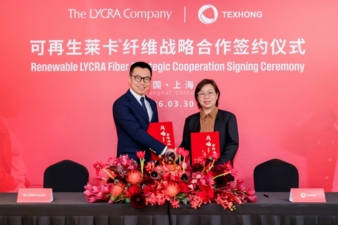
On April 6, 2026, The LYCRA Company announced the signing of a strategic partnership agreement with Texhong International Group Limited (“Texhong”). © The LYCRA Company
Under the agreement, Texhong will introduce the renewable LYCRA® fiber – containing 30 percent plant-based content derived from industrial corn, into the Chinese market for core-spun yarns. The material is engineered to deliver the same stretch, comfort and durability as conventional elastane. A cradle to gate assessment indicates a reduction in CO2 emissions of up to 32 percent compared with fossil based LYCRA® fibers.
Integration into established production systems
Texhong will leverage its long standing value chain for core-spun yarns to process the renewable LYCRA® fiber into tailored yarn solutions based on biobased raw materials. This creates a continuous, scalable approach from plant based feedstock to finished yarns within familiar manufacturing structures.
Joint development of future applications
Both companies plan to deepen their cooperation in biobased spandex, yarn engineering and brand specific end uses. Texhong highlights its long partnership with The LYCRA Company, which has already resulted in technological advances such as the dualFX® fabric technology. The new agreement builds on this foundation and aims to further accelerate the industrial adoption of biobased materials.
Momentum for sustainable textile solutions
The partnership combines performance with measurable sustainability benefits. For the textile value chain, the renewable LYCRA® fiber presents an opportunity to reduce reliance on fossil based inputs without compromising established product characteristics. With this step, both companies position themselves to meet growing global demand for innovative, renewable material solutions.