
18.11.25 – Advertisement
Textile hand feel becomes measurable
The emtec TSA Tactile Sensation Analyzer gives brands and mills one objective language for textile hand feel. With repeatable and reliable parameters, the measuring device revolutionizes the so far subjective human panel tests and provides a new level of transparency, where guessing was in place. In combination with the cloud-based Virtual Haptic Library the technology enables savings of resources from development to automatic batch approval.
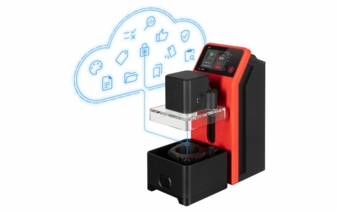
The TSA turns touch repeatable into objective data. © emtec Electronic GmbH
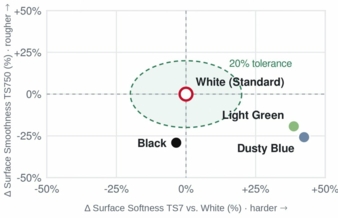
Case 1 Each color vs. the white Standard. Inside the ring = pass © emtec Electronic GmbH
Color stops the shopper. Touch closes the sale. 56% of shoppers worldwide say feeling the fabric is a top reason to shop in-store, and comfort, quality and durability are the leading apparel purchase drivers.1 Yet hand feel is still judged by human touch and that does not fit on a spec sheet. Reviewers reach different verdicts on the same swatch and “soft” means fluffy to one person and smooth to another. Every disagreement means another round of couriered swatches, in development cycles of around 20 weeks.
¹ Cotton Incorporated & COTTON USA, 2025 Global Lifestyle Monitor (13,026 consumers, 13 countries)
The TSA measures, what the human touch feels
The TSA turns touch repeatable into objective data. Rotor blades turn on the fabric, the sound spectrum reveals surface softness (TS7) and surface smoothness (TS750). A controlled load measures flexibility (D) and, on release, recovery (P, H, R). The complete standard test takes about 90 seconds with just one instrument. Three values carry most sourcing decisions: TS7 and TS750, where lower means softer and smoother, and D, where higher means more stretch.
From the physical library to a digital one
Every measurement is stored and secured in the Virtual Haptic Library, accessible worldwide. Each approved reference fabric becomes a digital Standard. New development samples, supplier submits and production batches are compared against it on screen, without a swatch in the mail. The brand sets a tolerance, typically 10% or 20%. A 10% difference in surface softness or surface smoothness is generally noticeable to consumers. Unlike color, direction matters: a fabric 10% softer than the Standard will usually pass, one 10% harder will not.
The method is proven: more than 750 TSA units work daily in the paper and tissue industry in 48+ countries. For textiles, GB/T 47784-2026 is published in February 2027 and an AATCC test method is in progress.
Two case studies, one test method
CASE 1 GARMENT-DYED TEES IN PRODUCTION: Four colors of one tee were measured against the white Standard. Flexibility stayed within 3.11 to 3.20 mm/N, so the construction was identical. Yet Dusty Blue and Light Green were about 40% harder and Black 29% smoother: the cause is color-driven finishing, not the fabric build.
CASE 2 BENCHMARKING A WHOLE PROGRAM: An apparel brand checked three alternative-supplier fabrics against its soft, smooth styles A and B. Submit 1 (PET/Tencel/spandex) was as soft as Style A and smoother than both: the closest match. Submit 2 had far less stretch (D 5.89 vs. 8.6 to 9.3 mm/N), revealing a different construction. Submit 3 was the roughest fabric in the program. Three sourcing decisions, made on data instead of swatches.
Next: The Standard approves the batch itself
Measuring takes seconds, but approval is still manual. The new Virtual Haptic Library (VHL) Pass/Fail module, debuted at the AATCC International Summit 2026, closes that gap. The brand sets two thresholds, and every batch is scored by its combined surface softness and surface smoothness distance from the Standard. In a trial with 14 fleece batches and thresholds of 7% and 17%, six batches were approved automatically, each with an approval ID linked to its PO and batch. Seven were queued for a technician’s hand-feel check; none were rejected.
Evaluating textile quality at the ITMA Asia 2026
At ITMA ASIA + CITME 2026, emtec Electronic GmbH will demonstrate with its collab partner James Xiang from Impaq Tech, how its TSA Tactile Sensation Analyzer determines the tactile feel of a textile. Besides, Alexander Grüner, Global Business Development Manager at emtec, will also be available at the International Textile Machinery Exhibition for technical discussions on the device’s measurement principles. Interested trade visitors at the National Exhibition and Convention Center in Shanghai from November 20 to 24 are invited to try one’s hand at this revolutionary technology for product development and quality assurance.