23/02/2026 – Research and Development Project — auf Deutsch lesen
Eco Yarn project demonstrates fibre potential
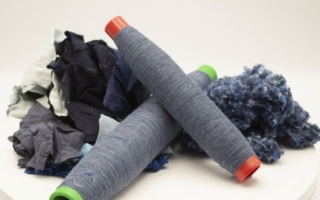
Discarded rental bedding formed the raw material for a new terry yarn containing 30 percent post-consumer recycled cotton. Tests in spinning and weaving confirmed the technical feasibility of the approach.
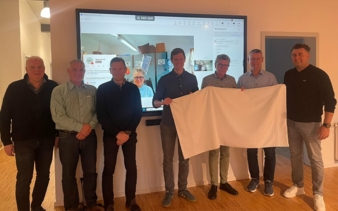
Celebrating the successful research and development project (from left to right): Andreas Merkel, Managing Director at Gebr. Otto; Werner Jochum, Head of Sales at Gebr. Otto; Thorsten Pitschke from the Bifa Environmental Institute; Cornelia Magno from Schwob AG (on screen); Dr. Georg Stegschuster, Head of the Recycling Atelier; Hans Spörry from Weseta; Reinhold Regittnig from Gebr. Otto; and Zlatko Donev, Production Manager at Weseta. © Gebr. Otto
Gebr. Otto, the Recycling Atelier at Augsburg University of Applied Sciences, Swiss rental textiles specialist Schwob AG and the weaving mill Weseta jointly carried out the project. Funding from the German Federal Environmental Foundation (DBU) enabled a scientifically supported evaluation of all process steps. Dr.-Ing. Georg Stegschuster, Head of the Recycling Atelier Augsburg, highlights the overarching potential: "Every year, around 12.6 million tonnes of used textiles accumulate in the EU. This represents enormous potential for secondary raw materials that has so far been insufficiently utilised. The prerequisite for high-quality recycling, however, is a raw material stream that is as homogeneous and traceable as possible." (translated from the original German)
Mechanical recycling and its limitations
The project used discarded rental bedding, a material with a defined composition and known usage history. Despite heavy wear from long service life, the material allowed a systematic assessment of its recyclability. During mechanical fibre extraction, the decisive role of fibre length became clear. Shorter fibres resulted in reduced strength. Carding proved particularly sensitive, requiring a balance between cleaning and fibre alignment. To ensure stable processing, the partners decided on a 30 per cent post-consumer recycled cotton blend.
Industrial trials at Gebr. Otto
Industrial-scale spinning at Gebr. Otto confirmed the findings from laboratory work. Recycled fibres generated additional fibre fly and increased cleaning requirements. Several machine speeds had to be reduced to maintain process stability. Under these conditions, a yarn of count Nm 28/1 was successfully produced.
Processing into terry fabrics
Weseta subsequently processed the yarn into terry fabrics. The weaving process remained stable, although fibre fly and visible irregularities in the yarn path were noticeable. A comparatively higher share of foreign fibres became apparent, particularly on lighter shades.
Environmental assessment and outlook
According to an ecological assessment by BIFA, the recycled yarn shows a 21 per cent advantage compared to a pure virgin cotton yarn. Andreas Merkel, Managing Director of Gebr. Otto, emphasises the significance of the results: "The towels used in the project had already gone through a long service life. In the rental laundry segment in particular, fibres are heavily stressed by numerous hot washing cycles. The fact that we still achieved a robust result is encouraging - also with regard to other textile applications." (translated from the original German)