
16.06.26 – Circular economy
Recycling of Carpets
Highly complex engineered technical textiles like industrially produced carpets have proved to be among the most difficult textile products to recycle.
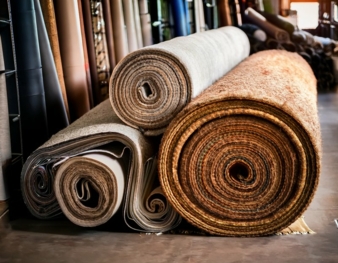
Modern industrially produced carpets are very difficult to recycle. © Carlene-AdobeStock / generiert mit KI
Companies are building the foundations of a more “circular” carpet floor coverings industry through investments in recycling infrastructure, redesigned product architectures and large-scale recovery programmes, according to a new 19-page report from the global business information company Textiles Intelligence.
Made from multiple types of materials
Modern industrially produced carpets are highly complex engineered technical textiles but they have proved to be among the most difficult textile products to recycle.
Such difficulty stems from a number of factors, not least the composite constructions of carpets. However, this is only part of the problem. Typically, face fibres, primary backings, secondary backings and adhesive systems are permanently bonded. Furthermore, the presence of latex and thermoset layers prevents economical separation, and sorting is complicated by tile constructions which are made from multiple types of materials.
For these reasons, the recycling of carpets remains a niche activity, and where it does occur it frequently takes the form of downcycling into lower-value applications rather than genuine fibre-to-fibre circularity. Furthermore, existing textile recycling systems lack the economic incentives and the structural coherence to achieve genuine fibre-to-fibre circularity.
Forthcoming ecodesign rules
However, there has been a structural shift in how floor covering products are conceived. Recyclability has had to become a design parameter rather than an optional sustainability feature—at least in Europe, as a result of regulatory pressures stemming from mandatory textile collection schemes, extended producer responsibility (EPR) schemes, and forthcoming ecodesign rules.
At the same time, advances in polymer chemistry and product architecture are demonstrating that high performance and material recovery need not be mutually exclusive.
Reflecting this, the number of chemical recycling technologies for polyamide and polyester is expanding while the development of monomaterial constructions illustrates how simplified polymer systems can unlock efficient fibre recovery.
Influential companies
Actively driving forward the recycling of carpets are five influential companies, namely Aquafil, Interface, Mohawk Industries, Shaw Industries, and Tarkett.
In particular, the companies are building the foundations of a more “circular” floor coverings industry through investments in recycling infrastructure, redesigned product architectures and large-scale recovery programmes.
When all of these developments are combined, they point towards a future characterised by circularity in which carpets can circulate through controlled material loops rather than accumulating as landfill waste.
Admittedly, significant technical and logistical challenges remain — particularly in the fragmented residential floor coverings market. But the direction of travel is increasingly clear.
For further information or to purchase this report, visit https://bit.ly/4cFPQ21